REVIEW · BASEL
Stories of Basel’s Old Town
Book on Viator →Operated by Basel Tourismus · Bookable on Viator
Basel’s Old Town tells stories fast. In just about two hours, you get a guided loop that connects quirky art, major churches, and civic power—starting at the Tinguely Fountain and ending near Spalenberg.
I like how the tour gives you a feel for Basel’s mix of old and new, not just postcard streets. I also like the easy walking pace, with frequent stops where your guide can explain what you’re actually looking at.
The main thing to watch is the bilingual format (English and German). Some groups have had trouble with audio and timing, so if you’re an English-only listener, stand closer to the guide and expect the pace to feel less “perfectly one-language” than you might hope.
In This Review
- Key points before you go
- Starting at Tinguely Fountain: Basel’s quirky opener
- Barfüsserkirche and the Historic Museum: churches that became storytellers
- Basel Minster and the red-sandstone skyline: the main photo moment
- The Museum der Kulturen Basel: why people-and-places belong in Old Town
- Marktplatz and the Old Town market feeling
- Town Hall (Rathaus): government in plain sight
- Andreasplatz: small shops, handsome houses, an easy ending
- How the 2-hour format really plays out
- Language setup: English offered, but expect bilingual reality
- Value check: why $33.18 can make sense here
- Practical tips to make the tour feel smooth
- Should you book Stories of Basel’s Old Town?
- FAQ
- How long is the Stories of Basel’s Old Town tour?
- Where does the tour start and where does it end?
- What languages are provided?
- Is there an admission fee for the stops?
- What’s the maximum group size?
- Can I cancel for a full refund?
Key points before you go
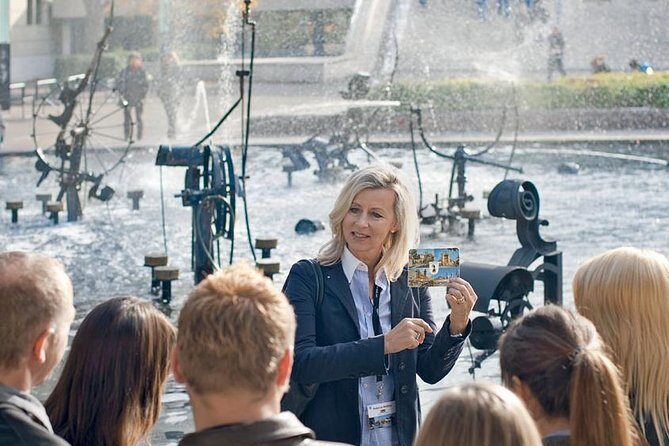
- Tinguely Fountain starts the show: sculptural “machines” by Jean Tinguely created in 1977, set where a city theater stage once stood
- Basel Minster is the headline: red sandstone walls, colorful roof tiles, and twin towers—plus the classic cathedral views
- You pass the civic center: Town Hall with a red facade, tower, and playful frescoes, right in the Old Town swirl
- Ethnography stop matters: the Museum der Kulturen Basel is known for major ethnographic collections in Europe
- Small group, but no magic hearing tech: up to 25 people, so position yourself for clarity, especially in bilingual groups
Starting at Tinguely Fountain: Basel’s quirky opener
Your walk begins at the Tinguely Fountain on Klostergasse, a playful way to kick off an Old Town tour. Basel didn’t just leave history alone here. In 1977, artist Jean Tinguely created sculptural machines in the fountain area, turning the spot into a modern landmark.
What I like about this first stop is the “why” behind it. The fountain sits where the stage of an old city theatre company once stood, so the tour immediately links art, memory, and urban change. If you enjoy moments where a city reuses space instead of freezing it in time, this start sets the tone.
You can also read our reviews of more tours and experiences in Basel.


Barfüsserkirche and the Historic Museum: churches that became storytellers
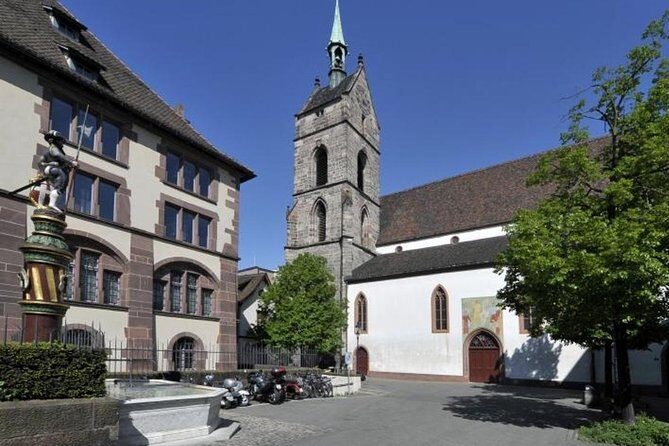
A short walk brings you to Barfüsserkirche, the church that now houses the Historic Museum of Basel. This is one of those Basel moves that feels very practical: a landmark church becomes a place for preserving and interpreting the city’s past.
Even if you don’t plan a deep museum session on this tour, the value here is orientation. Your guide helps you understand why the Old Town isn’t just pretty streets—it’s also where Basel curates meaning. And since this stop is marked with free admission, you can treat it as a low-pressure way to connect an iconic building to what Basel chooses to remember.
Basel Minster and the red-sandstone skyline: the main photo moment
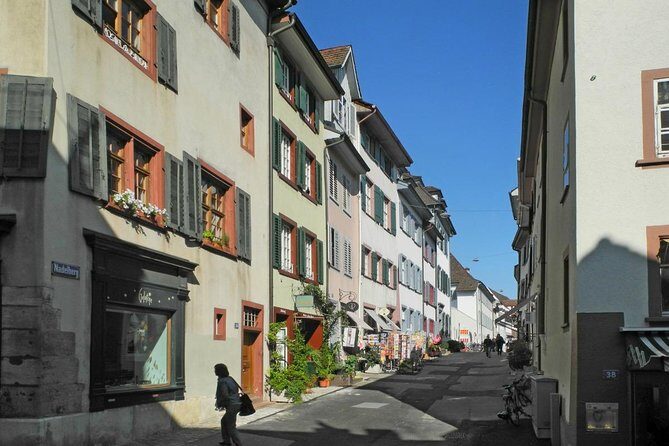
Then comes Basel Minster—the cathedral that, with the Mittlere Brücke, anchors the skyline view people associate with Basel. The building is unmistakable: red sandstone walls, colorful roof tiles, and twin towers that give the whole area a strong sense of place.
What makes this stop more than a quick look is the storytelling angle. Your guide ties the architecture to the city’s identity, so you’re not just staring at towers—you’re learning how Basel frames itself. The time on-site is short, but it’s enough to absorb the shape and colors and then understand why it matters in the broader Old Town layout.
One practical tip: keep your eyes up and also look sideways. Cathedral views often come from angles and bridge lines, not just front-on “cathedral selfie” moments.
The Museum der Kulturen Basel: why people-and-places belong in Old Town
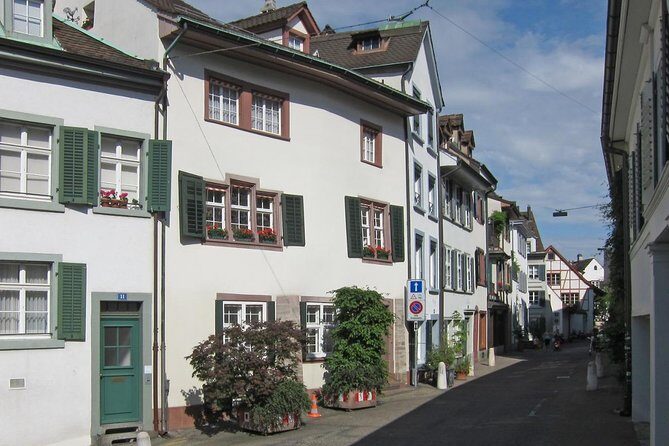
You’ll also spend time in the area connected with the Museum der Kulturen Basel, which ranks among Europe’s leading ethnographic museums. This is an important shift in the tour’s energy. After churches and civic buildings, you move into a museum theme that’s about cultures, collections, and how museums explain human stories.
Even without a long indoor visit, this stop helps you understand a key Basel trait: the city isn’t only tradition for tradition’s sake. It places learning and study into the fabric of daily urban life. For many visitors, this is what turns an Old Town walk into something more useful—because you leave with ideas about what Basel values.
Marktplatz and the Old Town market feeling
Next up is Marktplatz, the lively market square. It’s the kind of place where you can feel everyday Basel moving around you while still staying in the historical core.
This stop works best when you use it as a breather. Your guide passes along context, but you can also just watch how the square functions. If you’ve been touring churches and stone facades for a while, a market square gives your brain a rest while still keeping you grounded in real city life.




Town Hall (Rathaus): government in plain sight
As the walk continues, you pass the Town Hall, the seat of Basel’s government and parliament. It’s hard to miss with its red facade, prominent tower, and playful frescoes in the mix of Old Town buildings.
This stop is worth it because it adds a practical layer. It answers a question you might not even think to ask on day one: where does civic power sit in the city’s physical space? Basel’s Old Town isn’t just medieval atmosphere—it still has seats of authority right where you’re walking.
Andreasplatz: small shops, handsome houses, an easy ending
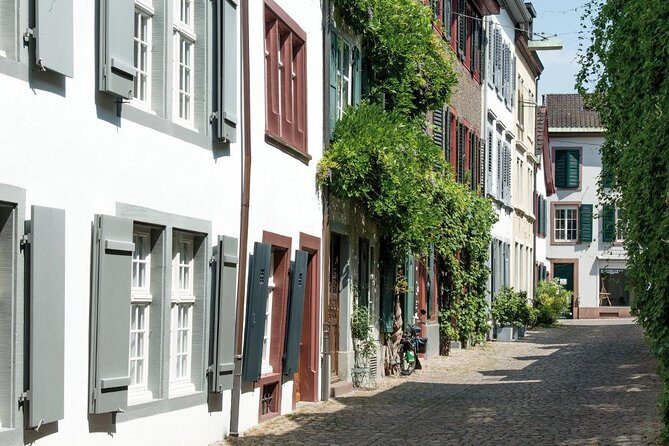
Toward the end, you reach Andreasplatz, a square surrounded by little shops and attractive houses. It’s a calmer, more “wanderable” finish before you head toward the endpoint near Spalenberg.
What you get here is a gentle transition. The big landmarks have already landed. Now you’re in a zone where it’s easy to imagine spending an extra hour browsing, grabbing a snack, or simply continuing your walk on your own.
How the 2-hour format really plays out
This is built as a fast, focused overview. You move between major Old Town markers with short stops, and the total time is roughly two hours. The tour is designed for moderate physical fitness, so it’s not a long slog—but it is still a walking experience.
The group size cap is 25, which is fairly comfortable for a guided walk. Still, in busy Old Town areas (and especially if you’re in a bilingual group), it helps to position yourself well. One solid strategy: don’t hang back. If the guide needs to repeat for language coverage, being closer makes a big difference.
Language setup: English offered, but expect bilingual reality
The tour includes commentary in English and German. Depending on the group composition (and timing from Sunday to Friday), the guide may provide bilingual commentary rather than a strict single-language flow.
This is where you should set expectations. Many guides can handle bilingual formats smoothly. But some people have found the balance uneven and felt they were waiting for translations or repeats. If you’re booking for English-first clarity, I’d treat this as a bilingual tour by design and come ready to work a little on listening.
Good news: a great guide can make bilingual narration feel like a feature, not a flaw. People have praised guides such as Doris, Susannah, Bea, Jasmin, Hugo, Isabelle, Sondra, Thomas, Caroline, and Mark for being engaging and funny while explaining how to read Basel’s streets.
Value check: why $33.18 can make sense here
At $33.18 per person for about two hours, the value is strongest if you want a guided “map with stories,” not a museum day. You cover several recognizable landmarks, including Basel Minster, Town Hall, and the Barfüsserkirche area tied to the Historic Museum of Basel.
Also, several stops are marked with free admission (like the fountain stop and the Minster stop). That matters in Switzerland, where add-on ticket costs can quietly stack up. So you’re paying mainly for guide time and direction—exactly what a short Old Town walk is best at.
One note on value: if you have a hotel-issued visitor card (often connected with the Basel Card), you might find on-site discounts available for Basel Tourismus-guided options. If you’re booking through a platform, you may not get that discount automatically. It’s worth checking what you’ll have in your wallet when you arrive.
Practical tips to make the tour feel smooth
- Wear comfortable walking shoes. Old Town cobbles look charming and still require good footing.
- In bilingual groups, stand where you can hear. If you’re stuck behind people, you’ll likely miss parts even with a small group.
- Bring layers. Basel weather can change fast, and walking tours don’t do “indoor time” unless the guide chooses it.
- Skip expectations about food. This experience is guide-only—no food or drinks included—so plan a snack stop after.
Should you book Stories of Basel’s Old Town?
Book it if you want a quick, guided sense of Basel’s Old Town identity—from quirky public art at the Tinguely Fountain to the cathedral skyline at Basel Minster, then into civic and museum-themed stops like Town Hall and the Museum der Kulturen Basel area.
I wouldn’t book it as your only Basel activity if you’re the type who needs a long museum visit, because this is not that. It’s a tour for getting oriented fast and learning how to notice things on your own afterward.
If your top priority is pure, uninterrupted English-only commentary, pay extra attention to the bilingual setup on your date and be strategic about where you stand. If you’re flexible and willing to listen closely, this is a solid way to learn Basel without spending your whole day in transit or lining up.
FAQ
How long is the Stories of Basel’s Old Town tour?
It runs for about 2 hours.
Where does the tour start and where does it end?
It starts at Tinguely Fountain, Klostergasse 7, 4051 Basel, Switzerland. It ends at Spalenberg, Basel.
What languages are provided?
The tour includes commentary in English and German. It’s also offered in English, and the guide may provide bilingual commentary depending on the group composition.
Is there an admission fee for the stops?
The stops listed for Tinguely Fountain, the Barfüsserkirche/Historic Museum area, Basel Minster, and other Old Town points are marked as admission ticket free.
What’s the maximum group size?
The tour has a maximum of 25 travelers.
Can I cancel for a full refund?
Yes. You can cancel up to 24 hours in advance for a full refund, based on the experience’s local time.