REVIEW · ZURICH
Self-Guided Audio City Tour in Zurich
Book on Viator →Operated by myFive · Bookable on Viator
Zurich feels like it has a soundtrack. This self-guided audio walk connects major sights with the stories behind them, from the Grossmünster to Cabaret Voltaire. I like that you get a professional English audio guide plus photos and step-by-step directions, so you’re not just hunting landmarks. One possible snag: the tour depends on your mobile internet, and weak signal can make playback act up or restart.
My favorite part is the route: it’s built like a tour of ideas as much as a tour of buildings. You’ll move from Swiss political history and Roman-era remnants to Reformation legends and modern art history—all at a pace you control. The main drawback is pacing; it’s labeled 2 to 3 hours, but it can take longer if you stop often, read captions, or linger inside churches.
In This Review
- Key points before you go
- How the self-guided audio tour actually runs
- Starting at Bahnhofplatz: Alfred Escher and the idea of Zurich
- Pestalozzianlage and Urania: education, enlightenment, and the cosmos
- Lindenhof Hill: the best views, plus a few emotional story beats
- St. Peter’s Church and the old center feeling
- Thermengasse Roman baths to Rathaus: old Zurich under your feet
- Cabaret Voltaire and Lenin Apartment: the city’s political and artistic shockwaves
- Grossmünster and Wasserkirche: Reformation towers and stained-glass light
- Ulrich Zwingli to Opernhaus: from reformer to composer
- Ganymed and Hans Waldmann: myth, power, and tragedy
- Fraumünster Church: Chagall stained glass and the one paid interior
- Paradeplatz, Augustinerkirche, and Weinplatz: modern Zurich and old guild life
- Max Bill’s Pavilion (#KiöR): the walk’s finish and a sense of modern values
- Pacing, timing, and how long it really takes
- Price and value: what $13.29 gets you
- Small practical tips that make it smoother
- Who this tour suits best
- Should you book this Zurich audio tour?
- FAQ
- What is the duration of the Zurich self-guided audio city tour?
- How much does the tour cost?
- Is the tour offered in English?
- Do I need internet and a headset?
- Is there a live guide during the tour?
- Are admissions included for all stops?
- Where does the tour start and end?
- Can I cancel and get a full refund?
- Is the tour private for my group?
- Is the audio accessible for a long time?
Key points before you go
- Audio + photos + directions: you get clear guidance along the route, not just a list of places.
- A mostly free-entry route: many stops are free, and only one interior visit is listed with an extra fee.
- First-time-in-Zurich friendly: you cover Old Town highlights and several major cultural stops in one sweep.
- You control the pace: it’s private for your group, and you can pause, replay, or skip.
- Bring power and a good signal: audio runs on a phone connection and can be disrupted if your battery or internet is shaky.
- The ending is in a great stroll zone: you finish near the Max Bill pavilion area on Bahnhofstrasse.
How the self-guided audio tour actually runs

This is a self-guided city walk with a mobile ticket. After booking, you use a link to access the audio tour, and you press play as you move from stop to stop. There’s no live guide—so your phone becomes the guide, the map, and the storybook.
You’ll need your own mobile phone with internet and a headset. That matters because this tour uses the connection to play the audio and load the experience. In practice, I’d plan for two things: keep your phone charged, and don’t wander too far off-route while audio is playing.
The format is built to be user-friendly: you get a high-quality audio guide recorded by a professional speaker, and the route includes photos plus detailed directions. If you prefer reading, one nice extra is that you can access a written transcript of the audio (handy for quick scanning when you don’t want to listen the whole time).
You can also read our reviews of more guided tours in Zurich
Starting at Bahnhofplatz: Alfred Escher and the idea of Zurich

You begin at Bahnhofplatz near the Alfred Escher Denkmal at 8001 Zürich. This is a smart starting point because Alfred Escher ties together two Zurich themes you’ll see repeatedly: money, and infrastructure.
At the Alfred Escher Statue, you’ll learn why Escher matters to the Swiss economy and the railway system. It’s short—about five minutes—but it sets a lens for the rest of the walk. Even if you’re not a rail-history person, the idea here is simple: Zurich’s identity isn’t only old churches and pretty streets; it’s also industry and planning.
Then the route moves toward the education side of the city.
Pestalozzianlage and Urania: education, enlightenment, and the cosmos
Next you stop at Pestalozzianlage, where you’ll see a monument for Johann Heinrich Pestalozzi. This one is a reminder that Zurich’s story includes schooling and social reform, not just politics and commerce. The visit is brief, but the message is clear: enlightenment wasn’t just a book idea—it shaped real systems.
Right after that, you get a stop for the Urania Observatory. The tour doesn’t ask you to do much; it’s more of a “gaze and get the context” moment. It’s a good pause to break up the walking and reset your attention before the climb to Lindenhof.
Lindenhof Hill: the best views, plus a few emotional story beats
Lindenhof Hill is where the tour slows down to give you breathing room. It’s listed as about ten minutes, and it earns that time because the hilltop views over Zurich and the Limmat River are exactly what you want early in a self-guided tour.
Here you’ll connect several landmarks through story. You’ll hear the narrative behind the Hedwig Fountain, see references to the Masonic Lodge architecture, and get a quieter moment with the Tombstone of Lucius Aelius. That mix is the point: this hill isn’t only a view deck; it’s a compact history lesson.
Tip: if you’re tempted to check your phone constantly, don’t. Once you find the right spot on the hill, just stand still for the audio segment. The views do the heavy lifting.
St. Peter’s Church and the old center feeling
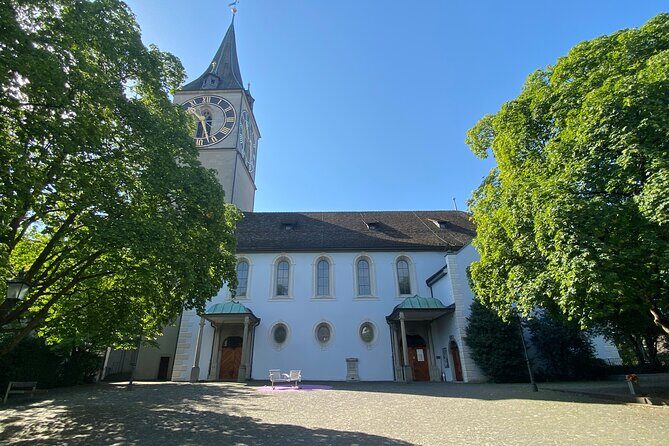
From Lindenhof you head to St. Peter’s Church, the oldest parish church in Zurich. Expect about ten minutes here, with the clock face as a standout feature. The tour also gives you a way to look beyond the obvious tourist photo—how the church feels as a calm pocket in the middle of an active city.
In a self-guided format, churches can go two ways: either they become a checklist, or they become a pause. This stop works best if you treat it as a moment to slow down. You’ll get the most out of it by stepping inside for a few minutes if it’s open.
Then the route ties religion and civic power together with Roman remnants and Zurich’s political spaces.
You can also read our reviews of more city tours in Zurich




Thermengasse Roman baths to Rathaus: old Zurich under your feet
Thermengasse brings you to the ancient Roman baths. You won’t be touring a full museum, but you will be looking at archaeological traces that link modern Zurich to Roman-era life. It’s listed at about five minutes, which is perfect here because you don’t want this stop to stretch into a full afternoon excavation.
From there you reach the Town Hall (Rathaus). Even with only a short stop (about five minutes), this helps you understand Zurich as a city shaped by institutions. It’s a good mental bridge between earlier ideas like economy and education, and later stops involving reform and art.
Cabaret Voltaire and Lenin Apartment: the city’s political and artistic shockwaves
Now the tour starts to feel less like a postcard walk and more like a human story. Cabaret Voltaire is the birthplace of the Dada movement, and it’s the kind of place that makes Zurich feel unexpectedly modern. The stop is short (around five minutes), but the concept is big: art here challenged norms on purpose.
Then you move to the Lenin Apartment Zurich, where Vladimir Lenin lived during political exile. This is one of the stops where the audio context matters, because you’ll get the echoes of that period without needing a long lecture. Again, the time listed is brief, but the subject naturally lands hard.
If you like Zurich for its calm surface, these two stops are the reminder that the city also hosted intense ideas—sometimes at the same time.
Grossmünster and Wasserkirche: Reformation towers and stained-glass light
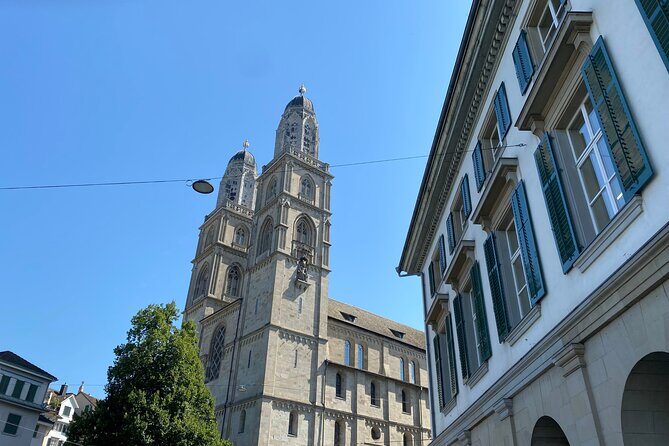
Grossmünster is one of Zurich’s signature sights, with its twin towers and big-name reform history. The tour gives you a guided way to notice its role in the Swiss Reformation, then points you toward the stained glass windows created by Augusto Giacometti. This is one of the longer stops on the list, about fifteen minutes, because it deserves time.
If you’re someone who usually rushes church interiors, this is the stop where you should resist. The stained glass is described as creating an interplay of light and spirituality, and even a quick look feels different than a quick glance from the street.
Next is Wasserkirche along the Limmat River. It’s listed at about five minutes, and it focuses on the stained glass windows that each tell a unique story. If you want a clean route logic, this section works well: one church ties to the Reformation, the next adds color, mood, and quiet detail.
Ulrich Zwingli to Opernhaus: from reformer to composer
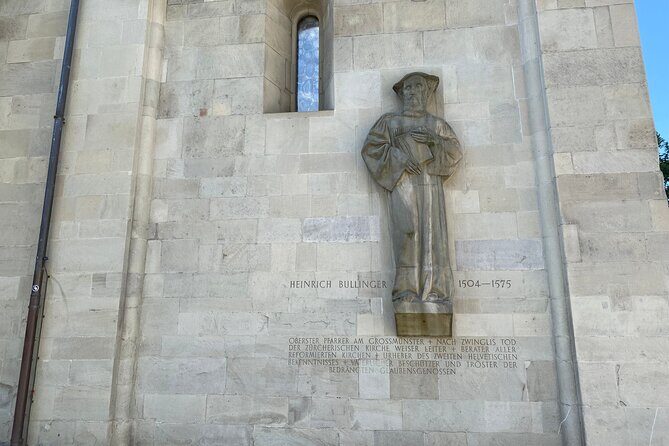
At the Ulrich Zwingli Monument, the tour shifts from buildings to people again. You’ll learn who Ulrich Zwingli was and why his work mattered for the Protestant Reformation. The stop is short (about five minutes), but it helps you interpret what you saw at Grossmünster—history stops being abstract.
Then you reach Opernhaus Zurich, the opera house. The tour calls out the facade’s busts of eminent composers and writers, so you can look up and notice the decorative program rather than just taking a wide shot. This is another quick stop (around five minutes), but it’s a nice cultural gear change after the heavier Reformation content.
Ganymed and Hans Waldmann: myth, power, and tragedy
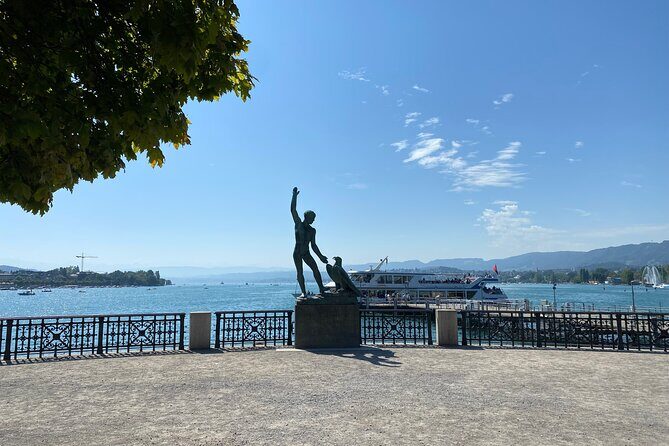
Ganymed is next, a sculpture linked to mythological narrative. The stop is listed at about five minutes, which fits what it is: a moment to notice art and symbol, not a museum detour.
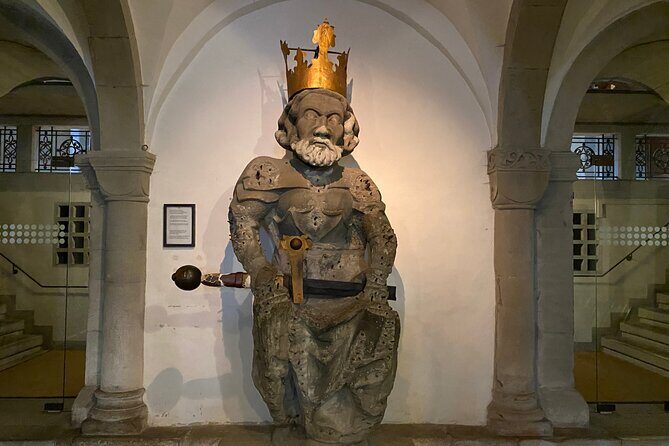
Then you come to the Hans Waldmann Statue. This is a powerful political story in stone. The tour notes his rise from humble beginnings to burgomaster, plus the tragedy of his death sentence. It’s one of those places where the audio context changes your reaction—you look at the statue differently when you know the arc of the life.
From here, the route heads toward Fraumünster and other church spaces, plus a financial district pulse.
Fraumünster Church: Chagall stained glass and the one paid interior
Fraumünster Church is the big church highlight, and it’s the only stop clearly listed with an extra interior fee. The church is known for its stained glass windows designed by Marc Chagall. The tour notes that if you want to see the church from inside, there’s an entrance fee listed as CHF 5 per person.
The interior is where you should spend your time. The tour describes light filtering through vibrant windows that tell unique visual stories and create an ethereal atmosphere. Even if you’re not a stained-glass superfan, the connection to Chagall gives you a reason to look longer than your standard church stop.
Paradeplatz, Augustinerkirche, and Weinplatz: modern Zurich and old guild life
After Fraumünster, the route shifts to Paradeplatz, Zurich’s financial district. This is about street-level energy—commerce meeting cosmopolitan city life. Expect a short stop that’s more about orientation and feeling than architecture deep-dive.
Then you visit Augustinerkirche, described as simple and quiet. It’s about five minutes, and it’s a good contrast: after the financial square feeling, you get a calmer religious pause.
Finally, Weinplatz brings you the Millers’ and Bakers’ Guild Building. The tour frames it as a way to understand worker life in historical Zurich. This is a nice closing combo to end on because it’s practical history—who built the city’s daily life.
Max Bill’s Pavilion (#KiöR): the walk’s finish and a sense of modern values
Your tour ends next to the Pavillon-Skulptur von Max Bill, 1983 (#KiöR) at Bahnhofstrasse 47. This stop is short (about five minutes), but it’s a thoughtful ending point: the tour describes it as symbolizing transparency, equality, and freedom.
Finishing here makes sense because you’re ending in an area that’s easy to keep exploring on foot afterward. If your legs are tired, you can also slide into nearby transit without a complicated detour.
Pacing, timing, and how long it really takes
The tour is labeled at 2 to 3 hours. In the real world, that range depends on how long you stop at churches, whether you read captions, and whether you replay audio sections.
I’d plan around a more flexible schedule. It’s totally normal for this kind of stop-heavy audio walk to run longer—especially if you want more than quick glances at interiors. If you’re on a tight day schedule, pick your priorities: at minimum, don’t skip the big church stops (Grossmünster and Fraumünster) if those are on your list.
Price and value: what $13.29 gets you
At $13.29 per person, the main value is not just the audio—it’s the structure. You’re paying for a route that strings together major attractions in an order that makes sense for walking, plus directions with photos so you waste less time second-guessing yourself.
Also, a lot of the stops are free to view. That means your money mostly goes to interpretation rather than admission fees. The one interior fee to watch for is Fraumünster (CHF 5 if you go inside). If you’re comparing to guided tours, this is a cheaper way to get the story layer without booking a specific time slot with a live guide.
Small practical tips that make it smoother
- Start with a charged phone. The tour requires internet and runs through audio across many steps.
- Use a decent headset. In a city like Zurich, street noise can make audio harder to catch.
- Stay close to the directions. If you wander off the route, it’s easier to get turned around.
- Pick your depth level. If you want fast orientation, skim the short stops; if you want context, linger at Grossmünster, Fraumünster, and Lindenhof.
Who this tour suits best
This works well for you if you want a self-paced Old Town orientation with real stories tied to major Zurich sights. It’s a strong fit for first-time visitors who like to understand why places matter, not just what they look like.
It’s also a good choice for people who prefer independence: you’ll go at your pace, pause when something catches your eye, and skip stops you don’t care about. Since it’s private for your group, it’s also calmer than joining a larger group schedule.
Should you book this Zurich audio tour?
Book it if you want a low-cost way to link Zurich’s big sights with the background that makes them click—economic Zurich, reform history, Roman traces, and modern art politics. At $13.29 with mostly free viewing stops, it’s great value if you’ll actually use the audio and directions.
Skip it or rethink your plan if you’re worried about relying on phone internet or you hate audio-based navigation. This tour is amazing when your tech stays stable, and frustrating when it doesn’t. If your battery runs low easily, bring a power bank.
FAQ
What is the duration of the Zurich self-guided audio city tour?
It’s listed as about 2 to 3 hours.
How much does the tour cost?
The price is $13.29 per person.
Is the tour offered in English?
Yes, it’s offered in English.
Do I need internet and a headset?
Yes. You’ll need your own mobile phone with internet and headset.
Is there a live guide during the tour?
No. There’s no live guide. You explore using the link provided after booking.
Are admissions included for all stops?
Many stops are free. Fraumünster Church is specifically noted as not included if you want to visit inside, with an additional fee listed as CHF 5 per person.
Where does the tour start and end?
It starts at Bahnhofplatz, Alfred Escher-Denkmal (8001 Zürich) and ends next to the Max Bill Pavilion Sculpture (1983 #KiöR) at Bahnhofstrasse 47, 8001 Zürich.
Can I cancel and get a full refund?
Yes, you can cancel for a full refund if you cancel up to 24 hours in advance.
Is the tour private for my group?
Yes. It’s described as private, so only your group participates.
Is the audio accessible for a long time?
You can access it for up to a year from the date of purchase, based on the provided tour info in the booking responses.