REVIEW · GENEVA
Self-Guided Audio Tour to the Many Faces of Geneva
Book on Viator →Operated by myFive · Bookable on Viator
Geneva turns moral lessons into street corners. This self-guided audio tour strings together famous stops like Jet d’Eau and St. Pierre Cathedral, but tells the story through human vices and virtues instead of just dates and facts.
I like the easy, photo-based directions between stops, which helps you keep moving without getting lost. I also like the tour’s clever angle: you’re nudged to think about things like pride, mercy, temperance, and justice while you’re standing right in front of the artwork.
One thing to consider: it’s tech-dependent. You need your own mobile phone with internet and headset, and weak data coverage can mean dropouts or slow loading.
In This Review
- Quick hits before you press play
- How the audio tour works (and why its theme makes sense)
- Starting at the Empress Sissi monument on Quai du Mont-Blanc
- Jet d’Eau and the monuments that ask uncomfortable questions
- National Monument and the Flower Clock: civic memory and pride
- Lutheran Church, the Palace of Justice, and Place Bourg-du-Four
- St. Pierre Cathedral and Town Hall: temperance, Jeremiah, and a stone bench
- The Reformation Wall and Guillaume-Henri Dufour’s fight
- Henri Dunant’s bust and the Red Cross, with a surprising parallel
- Finishing at the Fontaine de l’Escalade (or Bel-Air)
- Price and value: is $13.29 worth it?
- Time planning: can you finish in 1–2 hours?
- Tech checklist (this is the one thing that can ruin the day)
- Where this audio tour fits best (and where it might not)
- Should you book the Many Faces of Geneva audio walk?
- FAQ
- What language is the audio tour available in?
- How long does the self-guided audio tour take?
- Where do I start and where does the tour end?
- Do I need my own phone and headset?
- Is there a live guide?
- Are entrance tickets included for the stops?
- Is this tour private or shared?
- Is the tour available with a mobile ticket?
- Can I cancel for a full refund?
Quick hits before you press play
- A simple start-to-finish route from the Sissi monument area to the Fontaine de l’Escalade
- Clear stop-by-stop guidance with photos and directions so you don’t wander
- Landmarks tied to themes like pride, mercy, salvation, and courage (not just architecture)
- English audio with professional speakers for smooth listening
- Most stops are free to visit, so your money goes to the tour, not entrances
- Flexible pacing since it’s private and self-guided, but you still need stable internet
How the audio tour works (and why its theme makes sense)
This is a private, self-guided experience you do with your phone. After booking, you get a link to follow, and the audio plays as you move from stop to stop—no live guide, no group herding.
The big idea is that Geneva’s public art isn’t treated like neutral decoration. Instead, the tour frames monuments and religious sites through moral categories: sins like anger and envy, and virtues like justice and courage. That theme can feel preachy if you’re in a hurry, but it also does something useful: it gives you a mental hook for each place.
At $13.29 per person for about 1 to 2 hours, you’re basically paying for orientation plus storytelling. In a city where you can see a lot just by walking, this adds value by telling you what to notice once you’re already there.
You can also read our reviews of more guided tours in Geneva

Starting at the Empress Sissi monument on Quai du Mont-Blanc
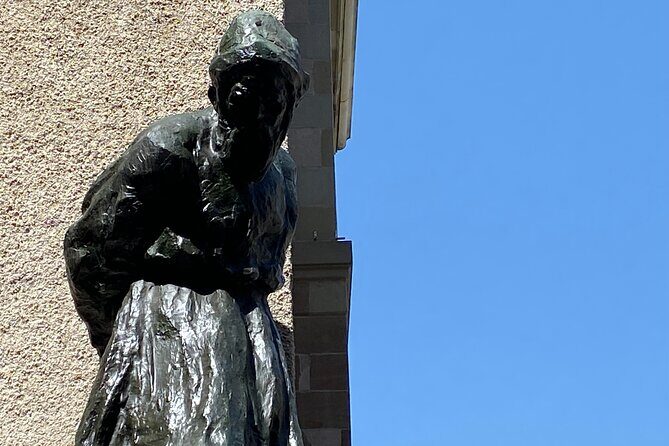
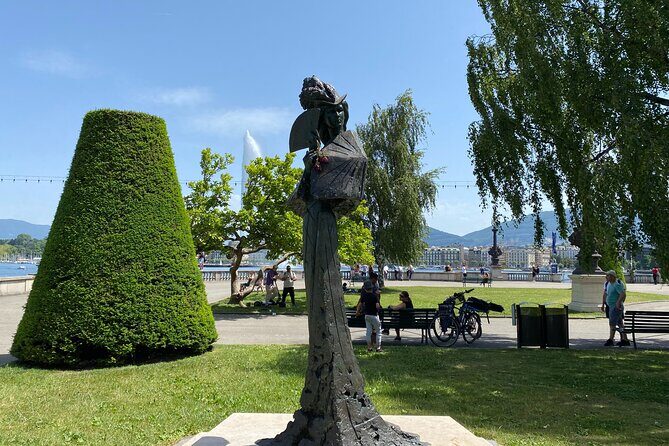
Your tour begins at the Monument to Empress Sissi on Quai du Mont-Blanc 10, 1201 Genève. It’s a smart opener because it’s close to the lakefront energy where Geneva visitors usually start drifting around anyway.
Stop 1 is focused on a tragic episode: an empress taken by an anarchist. The audio spends time on the how and, especially, the why. That sets the tone for the whole walk: you’ll be asked to connect public symbols to real human consequences, not just admire the stone.
If it’s hot out, you’ll appreciate having a timed structure from the start. Each stop is short enough to keep your momentum, but long enough for a real story.
Jet d’Eau and the monuments that ask uncomfortable questions

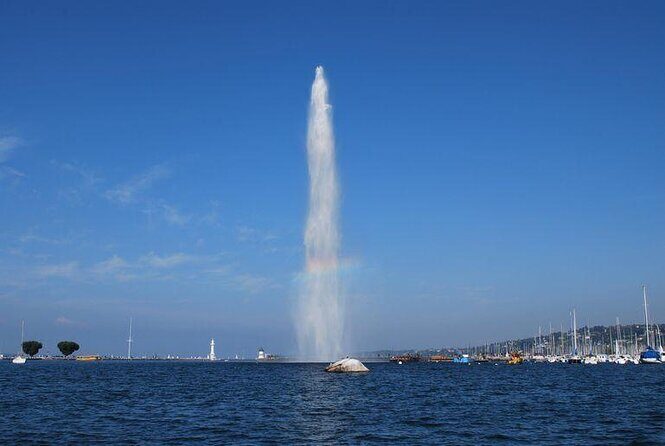
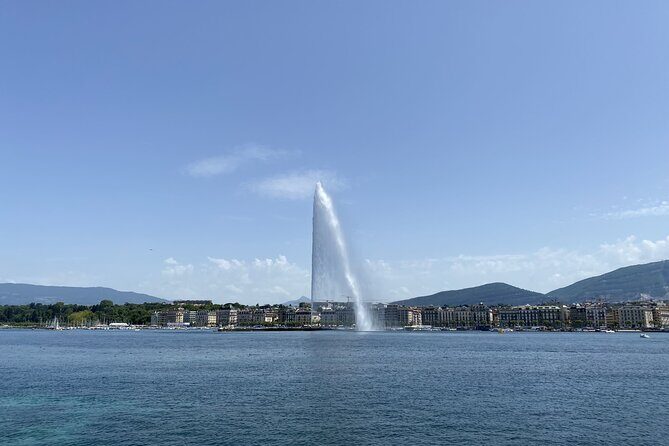
From Sissi, the next quick stop is Jet d’Eau, one of the largest fountains you’ll ever see in a city center. The audio prompts you to think about its role in making the world better—an angle that sounds almost poetic until you remember Geneva’s identity is tied to water, power, and public purpose.
Jet d’Eau is also useful as a pause point. You can reset your eyes, grab a photo, and get your bearings before the tour turns more interpretive.
Next comes the Brunswick Monument, dedicated by a benefactor. Here, the narration shifts toward what it means to give: why the donation mattered, and what virtues are shown in the imagery.
Then you hit the Statue de Jean-Jacques Rousseau. This one is blunt in theme: the audio points to sins Rousseau openly confessed. If you like your monuments with moral friction, you’ll probably enjoy how this tour doesn’t sanitize the past.
National Monument and the Flower Clock: civic memory and pride
The Monument National is the next stop, with an emphasis on a competition for erection—how the chosen design won. That’s a nice change from the more personal stories earlier, because it reminds you that big public works are also social decisions.
You follow that with the Flower Clock, which might look whimsical at first. The audio connects it to pride, which is exactly the kind of interpretive jump that makes this tour different from a standard “what you’re looking at” guide.
If you want a practical tip: use the Flower Clock moment to slow down and watch how people react. It’s an easy place to snap a clean shot and then move on before you lose energy.
Lutheran Church, the Palace of Justice, and Place Bourg-du-Four

At the Evangelical Lutheran Church of Geneva, the tour leans into religion and salvation. It explores different perspectives on how sins and good deeds affect a person’s chances—then points you toward nearby Palace of Justice for the connection to mercy.
That’s a strong pairing, because it links belief systems to how societies talk about wrongdoing. You’re not just listening in a vacuum; you’re standing near institutions that still shape the city’s self-image.
A few steps later is Place Bourg du Four, anchored by a monument tied to justice. The audio also brings up history tied to past red-light districts. This is one of the more direct “human reality” moments in the walk, and it helps balance the more solemn religious and judicial themes earlier.
If you’re sensitive to dark history, it’s worth knowing the tour doesn’t ignore it—it frames it, but it doesn’t glamorize it.
A few more Geneva tours and experiences worth a look

St. Pierre Cathedral and Town Hall: temperance, Jeremiah, and a stone bench
The tour’s most emotionally intense stop is Cathedrale Saint Pierre. The audio ties the cathedral’s association to temperance, then adds two major visual anchors: the statue of Prophet Jeremiah, often called the weeping prophet, and the Town Hall area.
The story doesn’t stay purely symbolic. It includes a stark detail about a stone bench where Geneva judges pronounced death sentences. That kind of moment can land hard, but it also makes the surrounding architecture feel less like a museum piece and more like a working part of civic life.
There’s also another smart reason this stop works: it’s long enough to absorb. The audio allocates about 20 minutes here, which gives you time to look up, orient yourself around the cathedral and town hall complex, and then let the story settle.
The Reformation Wall and Guillaume-Henri Dufour’s fight
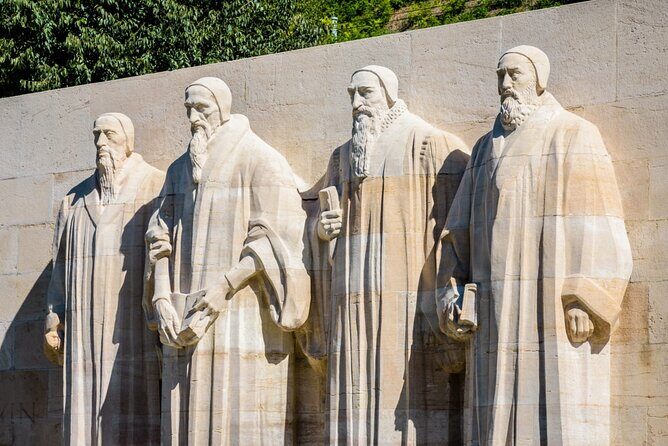
Next is the Reformation Wall. The narration focuses on which theologians were criticized for being inflexible, merciless, and heartless. This is not “Reformation 101.” It’s more like moral characterization, which fits the tour’s core theme.
From there you move to the statue of General Guillaume-Henri Dufour. The audio frames him around a valiant struggle against evil. It’s a shift from theological debate into action—good pacing for a walk that otherwise runs heavy.
If you like tours that connect ideology to people (not just to ideas), you’ll probably find this middle stretch satisfying.
Henri Dunant’s bust and the Red Cross, with a surprising parallel
The next stop is the Buste Henri Dunant, connected to the Red Cross founder. The audio explores the intricacies of his life and even draws surprising parallels with Leo Tolstoy.
That Tolstoy connection is a nice reminder that humanitarian themes show up across literature and politics, not only in institutions. It also gives you a fresh way to think about Dunant beyond the name recognition.
This is a shorter stop—about 10 minutes—so it doesn’t drag. You’ll likely feel ready for the final stretch after this one.
Finishing at the Fontaine de l’Escalade (or Bel-Air)
Your tour ends at the Fontaine de l’Escalade, Rue de la Confédération 4, 1204 Genève. The audio calls the fountain a testament to the courage of the Genevans.
This ending matters because it restores balance. After all the talk of judgment, sins, and harsh stories, you land on a symbol of collective endurance.
Practically, finishing at the city center makes it easy to keep your day going—coffee, a late lunch, or a wander through nearby streets while the last story is still fresh.
Price and value: is $13.29 worth it?
For $13.29 per person, the value depends on what you want from Geneva on your first visit. If you’re the type who likes a self-guided plan—walk, stop, listen, move on—this fits. You get main sight coverage, professional audio, and a route explained with photos and detailed directions.
What you don’t get is a live expert answering questions on the spot. If you want a back-and-forth conversation, you’ll need another kind of tour.
Still, for the cost, you’re buying two things that add up fast: structure and context. Geneva can be easy to “see” without really “getting it.” This audio walk helps you notice patterns—justice vs mercy, pride vs humility, temperance vs excess.
Also, the fact that it’s booked around 16 days in advance suggests it’s a popular way to get oriented without committing to a full guided tour timetable.
Time planning: can you finish in 1–2 hours?
The duration is listed as about 1 to 2 hours. In real terms, you’ll likely spend most time at the longer stops (especially St. Pierre), and the rest will feel like quick taps between landmarks.
Because each stop has an estimated length, you can use it as a pacing tool:
- If you want to race, you can move faster between the shorter points.
- If you want to slow down for photos, St. Pierre and a couple of other stops give you room.
I’d plan for a bit of flexibility if you’re traveling in hot weather. A short break is often smarter than forcing speed and missing visual details.
Tech checklist (this is the one thing that can ruin the day)
This tour requires:
- your own mobile phone
- internet
- headset
- the tour link provided after booking
That means signal strength matters. The experience can slow down or restart if your data coverage drops. There’s no offline download option provided here, so don’t assume you can save it for later when you lose service.
My practical advice: start the tour in an area where you know your phone gets decent data, then keep your path above-ground and avoid long dips into weak-signal pockets. Bring a charged phone battery too, because audio plus navigation plus photos adds up.
Where this audio tour fits best (and where it might not)
This is a great match if you:
- want a private experience (no waiting for others)
- like walking and learning at your own pace
- enjoy stories that connect monuments to moral themes like justice, mercy, courage, and salvation
It might feel like too much philosophy for you if your main goal is straight, practical historical dates and events. The tour’s tone leans into vices and virtues by design, so you’ll get more moral interpretation than standard “who built what when” facts.
Also, it’s ideal for an orientation walk when you’re new to Geneva. The route hits key sights in a logical order, so you finish with a stronger mental map.
Should you book the Many Faces of Geneva audio walk?
If you want an easy, structured walk through Geneva’s highlights and you don’t mind a moral theme running through it, this is a good buy at $13.29. The combination of clear photo directions and professional English audio makes it especially strong for first-time orientation.
If your phone signal is unreliable, or you hate being dependent on internet during sightseeing, you may find the tech stress not worth it. In that case, consider a tour that’s fully downloadable or entirely offline—this one clearly depends on connectivity.
FAQ
What language is the audio tour available in?
The tour is offered in English.
How long does the self-guided audio tour take?
It takes about 1 to 2 hours.
Where do I start and where does the tour end?
You start at Monument to Empress Sissi, Quai du Mont-Blanc 10, 1201 Genève, and you end at Fontaine de l’Escalade, Rue de la Confédération 4, 1204 Genève.
Do I need my own phone and headset?
Yes. You need your own mobile phone with internet and a headset.
Is there a live guide?
No. There is no live guide. After booking, you follow the tour using the link provided.
Are entrance tickets included for the stops?
For the listed sights, the tour notes admission ticket free for each stop.
Is this tour private or shared?
It’s private. Only your group will participate.
Is the tour available with a mobile ticket?
Yes, it uses a mobile ticket.
Can I cancel for a full refund?
You can cancel for a full refund by canceling at least 24 hours before the experience’s start time (based on local time). Free cancellation is available.